

Proofs and colour checks
Before brochures, catalogues and booklets go onto press, we run through the artwork, layout and production details in a practical order. This page explains what is checked, what you approve, and what helps the job move cleanly into print.
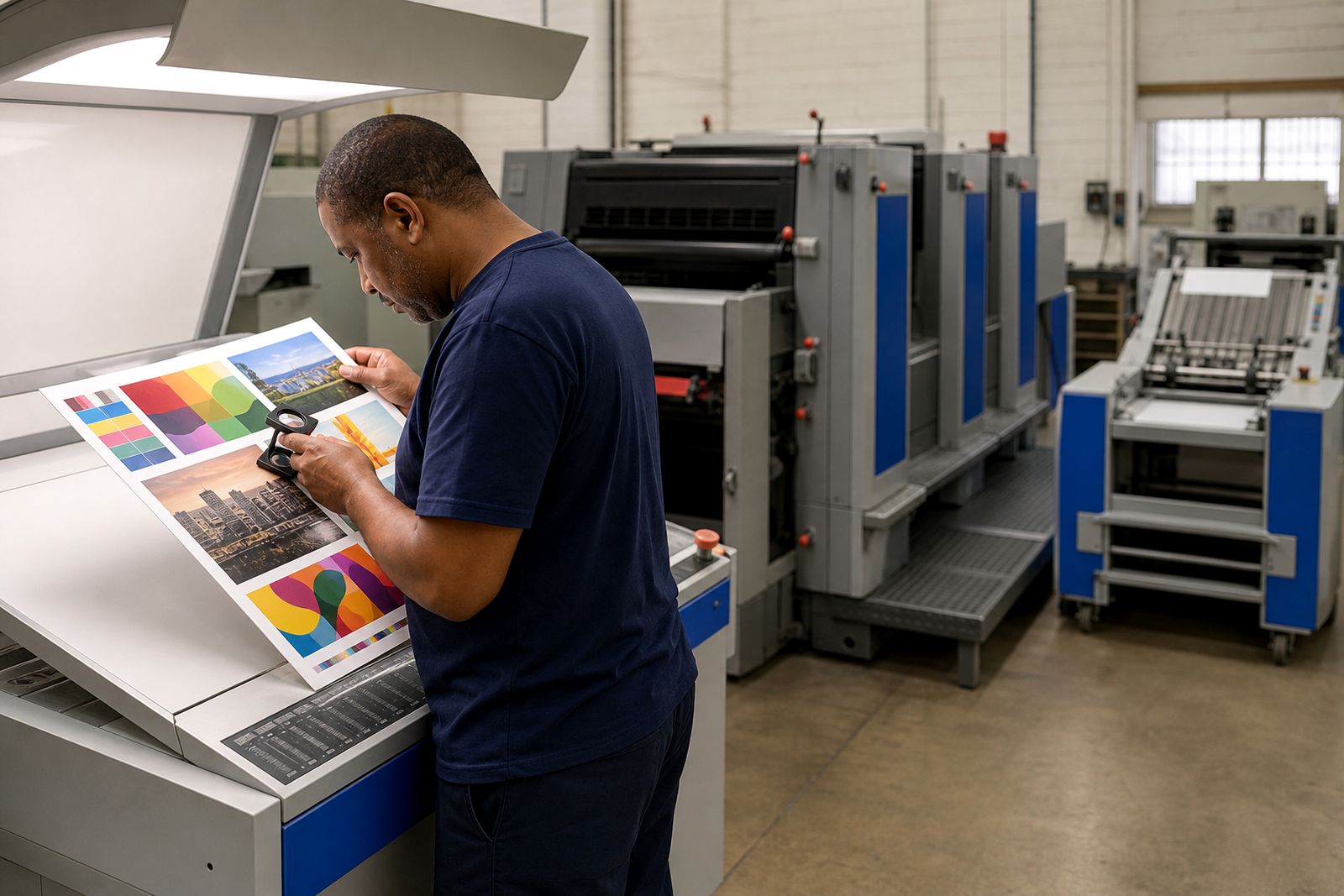
What is included before print
Every offset job needs a proper check before plates are made and sheets are booked for press. For work ordered through Offset Printing Online, that pre-press stage covers the artwork supplied, the page sequence, the finished size, the fold or binding method, and the way colour is expected to reproduce on paper. The aim is not to redesign the piece, but to spot production issues early and give you a proof to approve with confidence.
For brochures and catalogues, we look at the details that most often affect the printed result. That includes image quality, bleed, safe margins, panel widths on folded items, spine allowance where relevant, and whether the file setup matches the specification requested through our contact form. If something in the file does not suit offset production, we flag it before print rather than letting it become a costly press problem later.
- Artwork check against the ordered size and page count
- Review of bleed, trim and safe text positions
- Pagination check for multi-page work
- Colour review for CMYK offset output
- Proof issued before final print approval
- Finishing check for folding, stitching or perfect binding
How the proof stage works
Once we have your specification and artwork, the file is prepared for pre-press review. We compare the supplied document to the requested format, then generate a proof that shows the pages in position for approval. For a folded brochure, that means the panel order and fold logic are checked. For a stitched or perfect bound catalogue, we check running order, cover setup and any blank pages needed for production.
You review the proof and confirm that the content, sequence and general appearance are correct. Approval is the point where responsibility shifts from checking to production, so it is worth reading the proof properly rather than only scanning the cover. Small items such as a missed page number, a cropped logo, or a fold landing through a line of text can be easy to miss when a deadline is tight.
- Specification received through the online quote request
- Artwork reviewed for print readiness
- Production proof prepared and issued
- Client checks content, layout and page order
- Corrections, if needed, are supplied and rechecked
- Final approval clears the job for press and finishing
Colour checks on sheet-fed offset work
Colour matters differently across different printed pieces. A product catalogue with many item photographs needs consistent image handling across the full book, while a church programme or school booklet may be more sensitive to skin tones, logos and solid background areas. We check whether the supplied file is built for CMYK printing and whether any very bright screen colours are likely to shift when translated onto coated or uncoated stock.
Offset print gives stable colour over a run, but the result still depends on the file you send and the stock you choose. Lamination can deepen contrast a bit, uncoated sheets can read softer, and dark builds that look rich on screen can fill in on paper if they are set too heavily. We look for these production risks and raise them before approval. That said, a proof is not a new design round, it is a print check, so any substantive creative changes should be finished before the file reaches this stage.
Where a job contains brand colours, photographs and fine text on tinted backgrounds, it helps to mention which elements matter most. That gives our pre-press team the right context when checking the file, and it often prevents small but frustrating colour surprises on press.
What to prepare before you send artwork
The smoothest jobs are the ones where the artwork has already been packed for print rather than exported straight from a presentation file or office document. A properly prepared PDF gives cleaner type, more reliable image handling and fewer surprises with missing fonts or shifted objects. If the piece is a folded brochure, build it at the finished flat size with the correct panel plan. If it is a bound catalogue, provide single pages in reading order unless another layout has been requested.
Please check the content before submission. Spelling, phone numbers, product codes, map references and legal copy sit with the client for sign-off. We will pick up obvious production issues, but we are not the final author of your brochure or catalogue.
- Supply print-ready PDF artwork where possible
- Include bleed on all trimmed sides
- Keep important text clear of trim and fold lines
- Use CMYK images rather than RGB screenshots
- Outline or embed fonts when exporting correctly
- Name files clearly for cover, text and revised versions
How pricing is worked out at proof stage
Proofs and colour checks form part of the broader production costing, rather than sitting as an isolated line with a fixed figure for every job. The overall price is shaped by the finished size, page count, quantity, paper choice, number of printed sides, type of binding, and the finishing required after press. A simple leaflet proof is handled very differently from a thick perfect bound catalogue with a laminated cover and many image pages.
File condition also plays a part. Artwork that is already set up for offset print usually moves through pre-press with fewer interventions. If files arrive with missing bleed, mixed page sizes, low-resolution images or pages that need to be rebuilt to match the approved specification, that adds handling before the job can be released. We keep that process practical and tied to the actual work needed, not vague extras.
Courier delivery to provinces outside Cape Town is costed with the print job as part of the final production arrangement, along with packing requirements for heavier catalogue runs.
After approval and aftercare
Once the proof is approved, the job moves into print production, then into folding, saddle stitching or perfect binding as specified. After finishing, work is packed for collection from Epping or for courier dispatch to any province. For catalogues and brochures going to multiple branches, schools or regional offices, it helps to set that out early so packing can match the delivery split.
If you plan repeat runs of the same item, keep a record of the approved version, paper choice and finishing notes. That makes future reprints more consistent, especially where seasonal catalogue updates or quarterly brochure changes are involved. If you need guidance on file setup before sending artwork, the pages on artwork setup, paper stocks and brochure folds on this site cover the practical points in more detail.
Good proofs save time on press and avoid preventable waste, and that is really the point of the whole stage.
What our Brochure Printing customers say
Verified Google reviews
Questions we get asked
Does the proof show exactly how colour will look on the final paper?
A proof is used to confirm layout, pagination, trim, folds and general colour handling before print. Final colour can still shift slightly according to the chosen stock and finish, especially between coated and uncoated papers.
Can you fix mistakes found at proof stage?
Yes, provided corrected artwork is supplied for the pages that need attention. We can recheck the revised file before approval, but the proof stage is not intended as a full redesign round.
Who is responsible for approving the content?
The client signs off the wording, page order, contact details, product information and overall layout shown on the proof. Our role is to check print readiness and production fit before the job goes onto press.
Also worth a look
Tell us about the job
Send sizes, materials and where you are through our contact form, and we will come back with the practical options.
Open the contact form