

Perfect bound catalogues
Perfect bound catalogues give you a square spine, a neater shelf presence and enough room for larger page counts. They suit product ranges, company profiles, annual books and other multi-page work that needs a more book-like finish.
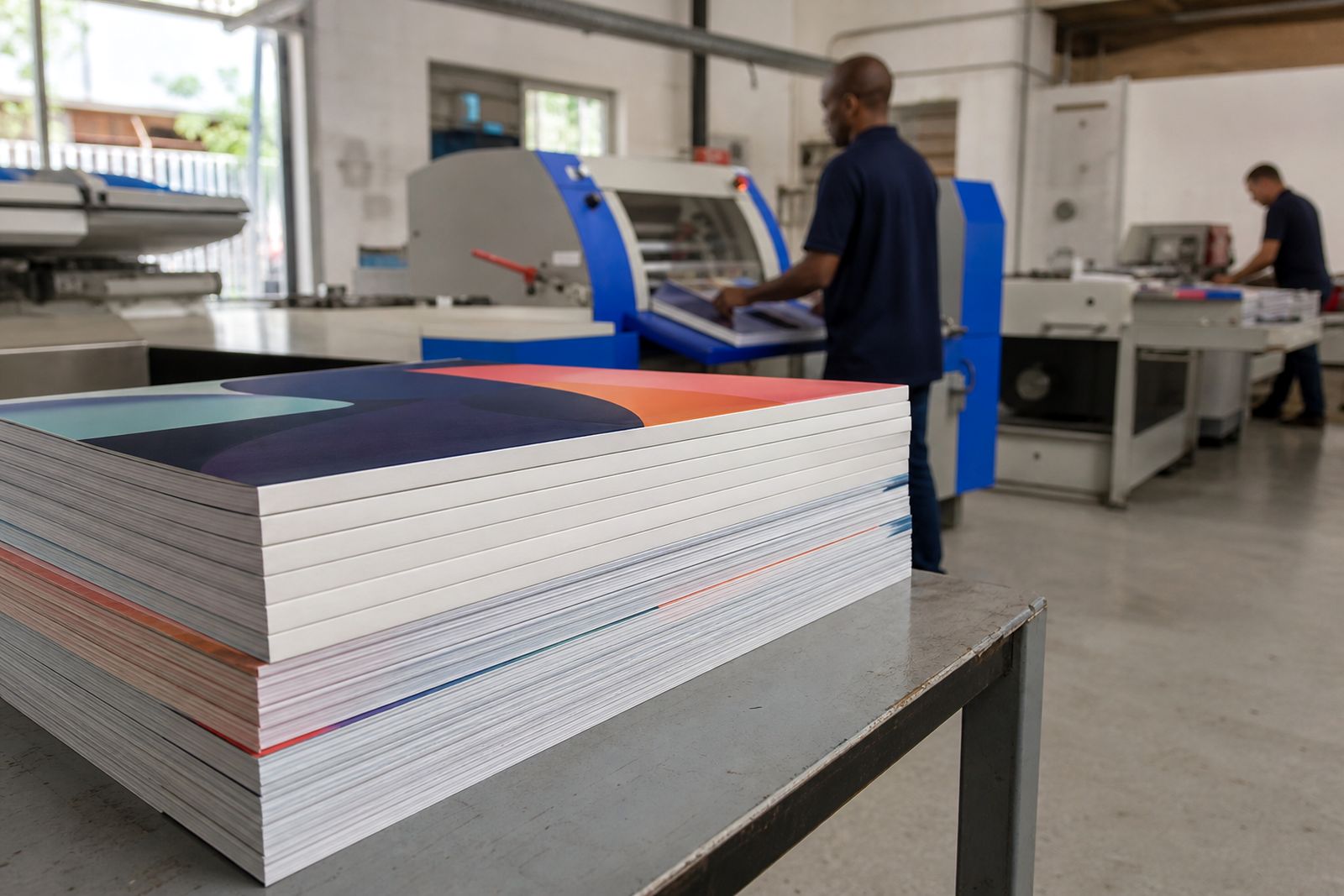
What a perfect bound catalogue is
Perfect binding uses gathered sections or stacked pages that are glued into a wrap-around cover, creating a flat front, back and spine. The result looks more like a softcover book than a stitched booklet, which makes it a practical choice when your catalogue needs more pages and a tidier edge.
For businesses sending sales packs around the country, or organisations producing annual reports and programme books, that square spine gives the document a more settled feel in the hand. It also allows spine text on thicker books, which helps when copies are filed, packed for reps or kept in a reception area for repeated use.
- Square spine for a more formal, book-style finish
- Best suited to higher page counts than saddle stitching
- Common for product catalogues, prospectuses, annual books and training manuals
- Printed on sheet-fed offset presses for steady colour and clean text
Sizes, page counts and working limits
Perfect bound catalogues are usually produced in A4 portrait, A5 portrait and square formats, although other trimmed sizes can be discussed if the layout and imposition work cleanly on press. A4 remains the most common for product-heavy catalogues because image size, tables and pricing blocks read more comfortably on the page.
There are a few practical limits to keep in mind. Perfect binding needs enough bulk in the text pages for the glue edge to hold properly and form a visible spine. Very low page counts are usually better as saddle stitched work, while very thick books may need a different binding route depending on stock choice and total extent. Heavy inside pages can also affect how well the book opens, so text stock and cover stock need to be chosen together rather than in isolation.
- Typical finished sizes: A4, A5 and square formats
- Text pages normally run in multiples that suit booklet imposition
- Low page counts are often better handled as stitched catalogues
- Very thick books may need a binding review before print proceeds
- Cover stock is generally heavier than the inside pages for better shape and handling
Where perfect binding works well
This format suits catalogues that carry a broad product range, technical listings, service directories or image-led editorial content over many pages. It is also a good fit for schools, churches and NGOs that need a polished programme, yearbook or publication that travels well by courier and stacks neatly at events.
Where it does less well is on short brochures, mailers or any job that must lie very flat across the centre spread. Because the spine is glued, there is some pull into the gutter, especially on thicker books. If a design relies on one continuous image across a spread, or tiny text close to the binding edge, we would usually advise changing the layout or considering a different format. That point gets missed quite often.
For product ranges with frequent updates, perfect binding also helps keep sections in one durable volume instead of several loose sheets. Sales teams often prefer that because pages stay together during transport between Cape Town, Johannesburg, Durban and smaller towns where handout stock is carried from meeting to meeting.
Paper, cover finishes and binding choices
The inside pages of a perfect bound catalogue are commonly printed on coated or uncoated stocks, depending on whether the job is image-led or text-led. Coated stocks give sharper photo reproduction and stronger colour contrast, while uncoated papers can feel less glossy and easier to annotate. Covers are usually printed on a stiffer board, then finished with matt or gloss lamination if extra scuff resistance is needed.
In coastal humidity, especially where boxes are opened and closed over several days, a laminated cover often helps the catalogue hold its appearance better during distribution. Spot varnish details can be added to the cover where the artwork suits it, but they need planning around folds, trim and the spine area.
- Coated text stocks for product images and colour-rich layouts
- Uncoated options for a softer reading feel and easier note-taking
- Heavier covers for shape, protection and a cleaner bound edge
- Matt or gloss lamination available on covers
- Spine width depends on page count and chosen stock combination
Artwork, proofing and production notes
For perfect binding, artwork setup matters more than many people expect. The spine width must be built from the final page count and stock thickness, the inside margins need enough room at the glue edge, and page order must be supplied as single pages rather than imposed printer spreads unless discussed otherwise.
We check files before print and issue a proof before production. That stage is where page sequence, cover alignment, spine text direction and image placement near the gutter should be looked at carefully. If your catalogue includes tables, SKU lists or fine rules, it helps to mention that in the brief so we can keep an eye on legibility during prepress.
There are no site installation requirements for this product, but there are handling details worth noting. Cartons should be kept dry, stored flat and not left in direct heat inside delivery vehicles or storerooms. Once unpacked, copies are best kept upright or in short, even stacks to avoid cover curl and edge knocks.
What to send when you ask for a quote
The clearest way to price and plan a perfect bound catalogue is with the main production details up front. If you already have artwork, say whether it is ready for print or still being corrected. If the job is still in layout, an estimated extent and sample pages are useful, even if a few items may still shift before final sign-off.
When you send your brief through our contact form, include the points below so we can assess the binding method, stock pairing and courier packing properly.
- Finished size, such as A4 portrait or A5 portrait
- Total page count including cover
- Quantity required
- Preferred text stock and cover stock, if known
- Any cover finish such as matt lamination or gloss lamination
- Whether the book must carry spine text
- Delivery town and province for courier planning
- Whether you need a printed proof or only a press-ready file check
If you are still deciding between stitched and perfect bound formats, it helps to mention that too. We can then assess the likely thickness, opening behaviour and overall look before the job goes to press.
What our Brochure Printing customers say
Verified Google reviews
Questions we get asked
How many pages do I need for perfect binding?
Perfect binding needs enough bulk at the spine to hold and finish properly. Short catalogues are often better as saddle stitched books, while larger extents usually suit perfect binding more naturally.
Can a perfect bound catalogue open flat?
It opens comfortably for reading, but it does not lie as flat as a stitched book. Important text and image details should be kept clear of the glue edge and centre gutter.
Can you print and deliver outside Cape Town?
Yes. We print in Epping and send brochures, catalogues and booklets by courier to every province in South Africa.
Also worth a look
Tell us about the job
Send sizes, materials and where you are through our contact form, and we will come back with the practical options.
Open the contact form