

Saddle stitched catalogues
Saddle stitched catalogues are folded sections gathered together and secured with two wire stitches along the spine. They suit product ranges, event programmes and company reports where you want a neat booklet that opens well and posts easily.
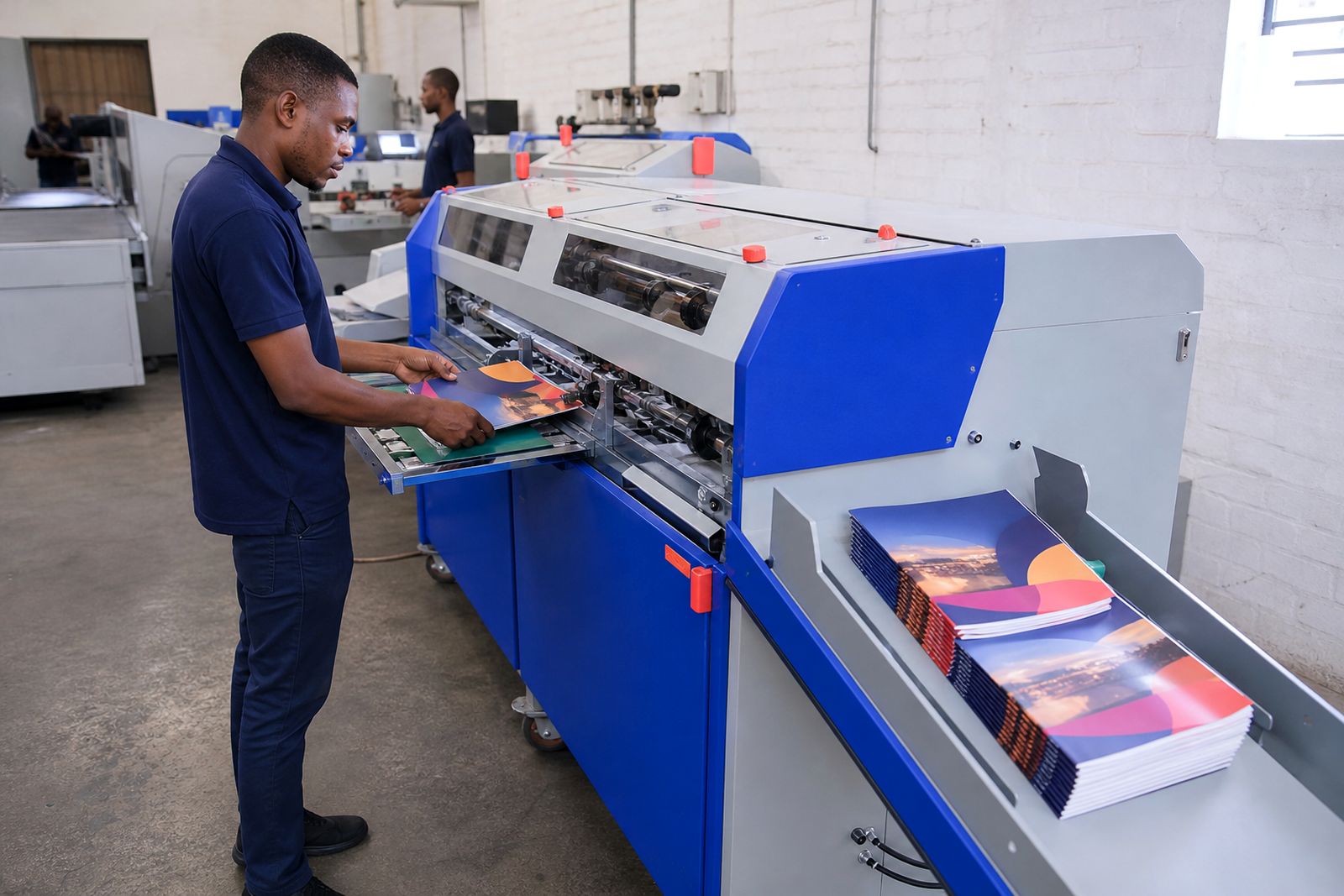
How a saddle stitched catalogue is made
For this format, printed sheets are folded, nested inside each other and stitched through the fold line at the spine. The finished piece reads like a booklet, with a clean front cover, inside pages and a back cover in one compact unit. It is a practical option when the page count is moderate and the publication needs to stay slim in the hand.
Because the sections are folded together, the total page count must run in page steps that suit booklet imposition. That matters at artwork stage, especially where contents, advert positions or product indexes need to land on a right-hand page. We check the file setup before print and issue a proof so pagination, spine behaviour and cover sequence can be checked properly.
- Two wire stitches placed on the fold of the spine.
- Best for slim to medium-thickness catalogues and booklets.
- Reads flat enough for easy browsing at a counter, meeting or foyer.
- Works well for courier distribution around South Africa.
Sizes, page counts and working limits
The common finished sizes are A4 portrait, A5 portrait and DL booklet formats, though square and custom sizes can also be planned where the layout justifies it. In retail and trade work, A4 is often chosen for fuller product information and bigger images, while A5 suits handouts, leave-behinds and compact programme books.
Saddle stitching has a natural limit. As page counts rise or heavier stocks are chosen, the spine gets fuller and the booklet starts to push out at the fore-edge. That effect, often called creep, can trim into margins if the artwork is packed too tightly. For thicker publications, perfect binding is usually the better route because it gives a square spine and more stable page block. If the booklet is very slim, the stitched format remains tidy and cost-effective on offset.
- Typical finished sizes: A4, A5, DL and selected custom formats.
- Page counts must be set in multiples that suit folded booklet sections.
- Inside margins need room for fold movement and trim tolerance.
- Heavier covers can be added, but very bulky combinations are better bound another way.
Where this format fits well
Saddle stitched catalogues suit publications that need to feel organised without becoming bulky. For product ranges with clear sections, seasonal offers, school prospectus pieces, church conference programmes and NGO reports, the format gives enough structure for proper reading while staying easy to carry. It also works well for mailers inserted into satchels or packed with samples.
There are jobs where it is not the right choice. If your catalogue has a high page count, a heavy text stock, tab dividers or long-term shelf use in a showroom, the stitched spine can start to feel limiting. A square-backed bound catalogue may sit better in that case. Likewise, if every spread carries detailed tables tight to the centre fold, the design should allow for fold movement and page crossover shift, otherwise fine detail can look cramped.
For Epping clients collecting from our office and for courier deliveries to other provinces, this format packs efficiently, which helps keep cartons manageable in transit.
Paper, cover options and finishing details
Most stitched catalogues use a lighter stock for the inside pages and a firmer cover stock to give the booklet a bit more presence. A matt or gloss coating can be added where extra surface protection or a different look is needed. For product books that will be handled often at a counter, a laminated cover can help resist scuffing and damp marks, useful in coastal areas where humidity gets into everything by mid-morning.
Folding accuracy matters on stitched work because every sheet builds from the centre outward. We allow for trim, fold and image crossover during prepress checks, but the artwork should also be built with sensible margins and bleed. If the publication contains colour-critical product images, note that when you send the brief so the proof stage can focus on those pages first.
- Self-cover booklets are possible for lighter, shorter pieces.
- Separate covers give a stronger outer wrap and cleaner feel.
- Matt or gloss finishing can be added to the cover.
- Spot UV is usually reserved for cover elements rather than full inside pagination.
Handling, storage and day-to-day care
Printed catalogues travel well, but they should be kept flat in their cartons until use. If packs are left upright for long periods in a hot storeroom the fore-edge can start to fan slightly, especially with fuller stitched books. In Cape Town’s wetter months, avoid placing cartons directly on a concrete floor where moisture can creep up into the board wrapping.
Once opened for use, store small stacks on a clean shelf or counter away from direct sun. If the catalogue is going into field kits or vehicle stock, keep it in a sleeve or folder so the corners do not bruise. A stitched booklet is durable for regular handling, but like any printed piece the fold line and cover edges will show wear if it is passed around for weeks on end.
For venue programmes and handout packs, tell us whether the cartons need to be split by branch, province or event date, it saves a lot of resorting later.
What to send with your enquiry
When you send a catalogue brief through our contact form, the useful details are the finished size, page count, quantity, preferred binding style, and whether the cover should differ from the inside pages. Also mention if the file is ready for print or still being prepared, because that changes the preflight checks we need to apply. If there are versions by language, branch or region, note that upfront so we can plan them as matched sets rather than separate last-minute jobs.
Please include the delivery town, any split quantities, and whether this is a product catalogue, annual report, programme or booklet. If there are pages where colour matters more than the rest, point those out early. We will check artwork setup, supply a proof before print and finish the job with folding and stitching before courier dispatch.
- Finished size and orientation.
- Total page count, including cover.
- Quantity and any split by location.
- Paper preference for inside pages and cover.
- Any lamination or special cover finish.
- Delivery town, branch details and packaging notes.
What our Brochure Printing customers say
Verified Google reviews
Questions we get asked
Can a saddle stitched catalogue have a thicker cover?
Yes. A firmer cover stock is common and gives the booklet a cleaner outer wrap. The final page count and paper combination still need to stay within the practical limit for stitching.
Is this binding suitable for a large product range?
It depends on the page count and how much information sits on each spread. For a moderate range it works very well, but a bulky catalogue with many pages often suits perfect binding better.
Do you check the artwork before printing?
Yes. We run artwork checks, look at pagination and bleed, and issue a proof before print so the booklet sequence and key pages can be confirmed.
Tell us about the job
Send sizes, materials and where you are through our contact form, and we will come back with the practical options.
Open the contact form